
 English

Views: 0 Author: Site Editor Publish Time: 2025-11-24 Origin: Site


Marble is a timeless material used in many construction and design projects. But cutting marble without the right tools can be challenging. A diamond blade is essential for achieving clean, precise cuts.
In this article, you’ll learn how to use a diamond blade to cut marble effectively and avoid common mistakes.
Marble is composed of calcium carbonate, primarily made up of the mineral calcite. This composition gives it its strength but also makes it more prone to damage during cutting, especially along the veins. Understanding the mineral structure of marble helps in selecting the right cutting tools and techniques to prevent unwanted cracking or chipping.
Marble ranks around 3-4 on the Mohs scale of hardness, which is relatively softer compared to materials like granite. However, its surface is still tough enough to require a powerful cutting tool. Diamond blades, thanks to the hardness of the diamond particles embedded in the edge, can easily slice through marble's relatively soft surface while preserving the stone's integrity.
When cutting marble, you might face challenges such as cracking, chipping, or overheating of the blade. These issues arise mainly due to improper technique, poor blade quality, or using the wrong type of blade. Proper preparation and technique are essential to overcoming these challenges.
Diamond blades are specifically designed to handle tough materials like marble, granite, and concrete. The diamond grit along the edge of the blade efficiently grinds through the marble, creating clean and precise cuts. The sharpness of the diamond particles ensures smooth slicing without excessive friction, preventing damage to the material being cut.
Compared to other blades, such as carbide or steel blades, diamond blades are far superior for cutting marble. While carbide blades might work on softer stones, they often wear out quickly when cutting through marble due to the stone’s density. Diamond blades, on the other hand, provide a longer lifespan, better precision, and faster cutting speeds.
For cutting marble, you’ll typically use one of three types of diamond blades: segmented blades, continuous rim blades, or turbo blades. Segmented blades are ideal for dry cutting and heavy-duty jobs as they allow debris and dust to escape more easily. Continuous rim blades provide smooth, chip-free cuts and are best used with wet cutting methods. Turbo blades have a combination of both features and are ideal for quick cuts with minimal chipping.
Blade Type | Features | Best For |
Segmented Blade | Gaps between segments for better cooling and debris removal | Dry cutting, thick marble |
Continuous Rim Blade | Smooth edge for clean, chip-free cuts | Wet cutting, fine cuts, visible edges |
Turbo Blade | Serrated edge for fast cutting | Quick cuts, rough cuts |
Choosing the right diamond blade is crucial for efficient cutting. Factors to consider include the blade type (segmented, continuous rim, or turbo), the diameter of the blade, and whether you plan to cut wet or dry. For marble, continuous rim blades are recommended for their smooth and precise cuts, especially when wet cutting.
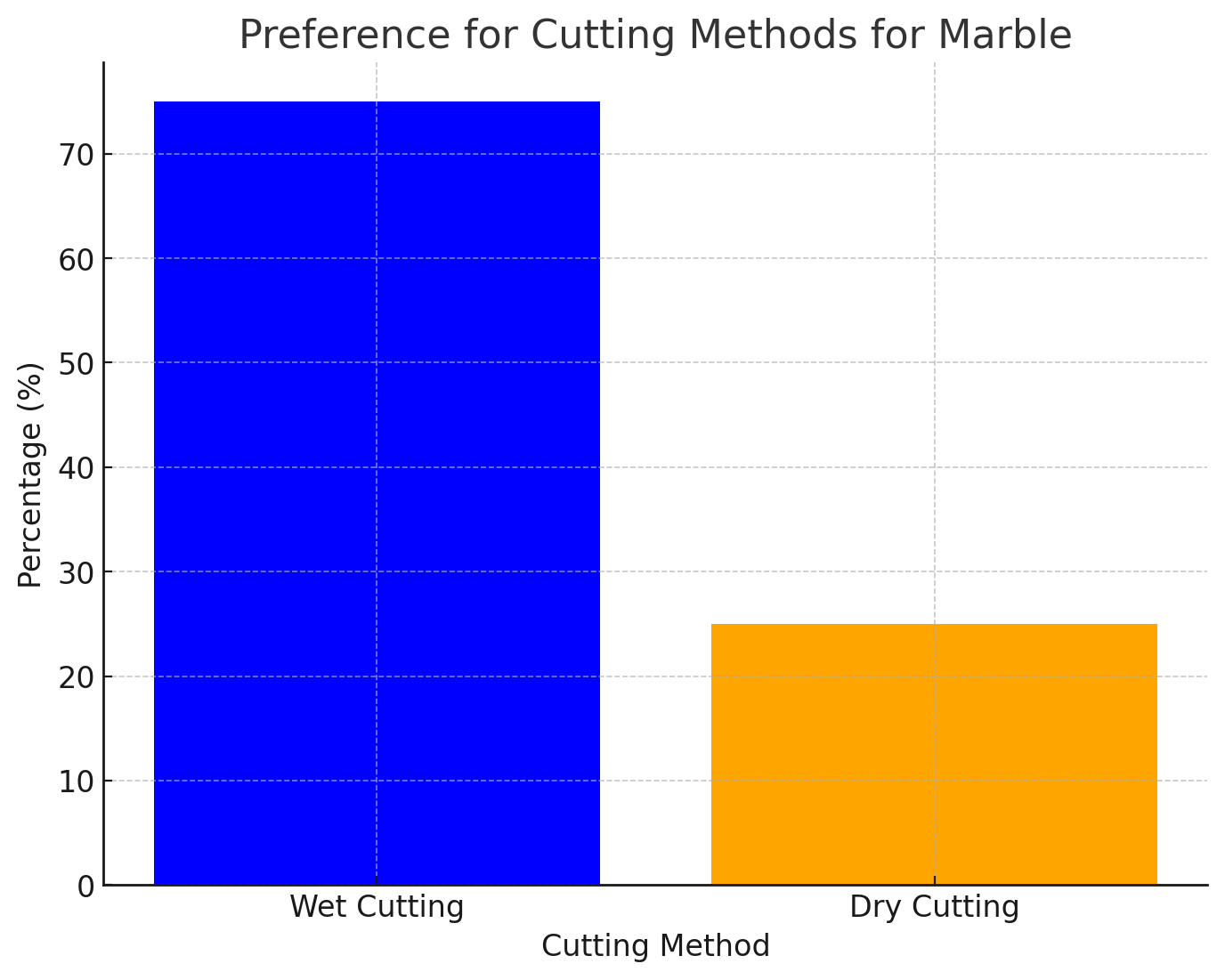
While both wet and dry cutting methods are available, wet cutting is generally recommended for marble. It keeps the blade cool, prevents overheating, reduces dust, and minimizes the risk of chipping. If you opt for dry cutting, it’s essential to frequently pause to allow the blade to cool and prevent excessive heat buildup. Wet cutting, though slower, ensures a higher-quality cut with fewer mistakes.
Feature | Wet Cutting | Dry Cutting |
Cooling | Uses water to cool the blade | No cooling system |
Dust Control | Minimizes dust significantly | Generates more dust |
Blade Life | Extends the blade's life | Reduces blade life faster |
Suitable For | Larger cuts, thick marble slabs | Quick, smaller cuts |
Health Considerations | Safer (less dust, less heat) | More dust, riskier for health |
Before starting, ensure that your equipment is set up properly. A high-quality wet saw with a diamond blade is ideal for larger cuts, while an angle grinder or handheld saw with a diamond blade can be used for detailed cuts. Make sure the marble is securely placed on a flat surface, and the saw is calibrated to the correct cutting depth. Always wear proper safety gear, including eye protection, gloves, and a dust mask.
1. Measure and Mark the Cut: Start by measuring the area where the marble needs to be cut. Use a pencil or marker to draw the cutting line. For curved cuts, you can use a template or pattern.
2. Secure the Marble: Place the marble on a stable surface or workbench. Use clamps or a vice to hold it securely in place to prevent any movement during the cut.
3. Make the Cut: Turn on your saw and slowly feed the marble into the blade. For wet cutting, ensure that water is continuously supplied to the blade to keep it cool. Maintain a steady speed and avoid forcing the blade through the material.
4. Finishing the Cut: After completing the cut, check for any rough edges or imperfections. You can use a sanding block or a polishing pad to smooth the edges if necessary.
To avoid cracking or chipping during the cutting process, always cut slowly and allow the blade to do the work. For delicate cuts, use painter’s tape along the cut line to reduce the risk of damage. Ensuring the marble is firmly secured will also minimize movement during cutting.
Diamond blades are durable, but regular maintenance is essential to prolong their lifespan. After each use, clean the blade to remove any stone debris or slurry buildup. If the blade shows signs of wear or becomes dull, it’s time to replace it to maintain cutting efficiency.
Cutting marble can produce dust and sharp fragments, so always prioritize safety. Wear protective glasses, gloves, and a dust mask to shield yourself from dust particles and debris. When using a wet saw, ensure proper water delivery to avoid overheating the blade and to reduce dust in the air.
Safety Gear | Purpose |
Safety Glasses | Protect eyes from debris and dust |
Dust Mask/Respirator | Prevent inhalation of marble dust |
Ear Protection | Protect from noise generated by the saw |
Gloves | Protect hands from sharp edges and vibrations |
Overheating is a common issue when cutting marble, especially with dry cutting methods. If the blade gets too hot, it can warp or crack, compromising the cut. Ensure that the blade is continuously cooled, especially if using a dry cutting method. Take breaks to allow the blade to cool down between cuts.
Chipping along the edges of marble can occur if the blade is too aggressive or the cutting speed is too fast. To minimize chipping, use a continuous rim blade and make multiple shallow passes instead of one deep cut. Ensure the marble is adequately supported and the blade is sharp.
Uneven cuts can happen if the marble shifts or the saw guide isn’t aligned properly. Always check that the marble is securely fastened and use a straight edge to guide the saw. Take your time, and avoid rushing the cutting process to ensure a straight, precise cut.

An angle grinder with a diamond blade is ideal for smaller or curved cuts. However, angle grinders can generate a lot of dust and heat, so it’s important to use water to cool the blade if possible. Slow, steady pressure is key to avoiding cracks or damage to the marble.
For minor marble cutting tasks, such as trimming small tiles or making quick cuts, manual tools like tile cutters can work. However, these tools are not suitable for larger slabs or thicker marble. Always ensure the blade is sharp and appropriate for cutting marble.
Cutting marble with a diamond blade requires precision and the right tools. By selecting the right diamond blade and opting for wet cutting, you can achieve professional-quality results. With careful technique and safety precautions, you'll work efficiently. Huazuan Diamond Tools offers high-quality diamond blades designed to ensure smooth, precise cuts, making your marble cutting tasks easier and more effective.
A: A diamond blade is a cutting tool with diamond particles embedded in the edge. It's ideal for cutting hard materials like marble due to its durability and precision.
A: No, regular saw blades aren’t designed for marble. A diamond blade is necessary to handle marble’s hardness and ensure clean, precise cuts.
A: Wet cutting uses water to cool the blade and reduce dust, while dry cutting doesn’t use water but may generate more heat and dust.
A: To prevent cracks, use steady pressure, a slow pace, and ensure proper cooling when using the diamond blade.
A: Regularly clean the blade, avoid excessive heat, and inspect for wear to maintain its performance and longevity.


 No.351, Dingshi Jing, Shijing, Dongling Town, Huian, Quanzhou, Fujian, China
+86-595-86780371
+86-15905012435


