
 English

Views: 0 Author: Site Editor Publish Time: 2026-08-17 Origin: Site


Selecting the right components for granite block cutting represents a constant balancing act in any processing plant. You must continuously juggle feed speed, tool longevity, and energy consumption to keep production lines profitable. Incorrect selection often triggers severe operational headaches down the line. It directly causes high power consumption, premature blade wear, uneven slab thickness, and excessive machine downtime. Ultimately, ignoring these factors drains your daily operational budget and slows delivery schedules.
This guide helps plant managers and procurement teams build a verified framework for evaluation. You will learn how to source, test, and validate segments using objective performance metrics rather than relying on standard marketing claims. By adopting a methodical approach, you ensure your equipment operates at peak capacity while protecting your material yields.
The Bond Dictates the Cut: Harder granite requires a softer metal bond to expose new diamonds continuously; softer, abrasive granite requires a harder bond to retain diamonds longer.
Structure Matters: Selecting between M-shape, stepped, or sandwich designs directly impacts the initial cutting bite and coolant distribution.
Machine Alignment: A segment designed for a single block cutter will fail or underperform if applied to a high-tension multi-saw setup.
Data-Driven Evaluation: True stone cutting efficiency is measured by the total cost per square meter, factoring in blade life, power draw, and production throughput.
Every plant manager faces a primary trade-off during procurement. Cutting speed and segment lifespan share a strict inverse relationship. Highly sharp segments cut fast but wear down quickly. Conversely, highly durable segments last longer but cut slower. You must define which metric matters most for your specific overhead costs and order volume. Evaluating a tool requires establishing clear priorities beforehand.
Optimal segments heavily influence your power consumption metrics. The right formulation reduces the amp draw on your main motor. This drop translates into direct, measurable energy savings. Lower resistance means the machine works less hard to push the blade through the stone block. Over a monthly billing cycle, improved stone cutting efficiency significantly reduces utility expenses.
Cut quality directly impacts your material yield. Dull segments force the blade to deflect laterally. Deflection leads to tapered cuts, uneven slab thickness, or even catastrophic slab breakage. These material losses often cost significantly more than replacing the blades themselves.
To avoid these pitfalls, establish a strict decision matrix before engaging suppliers:
Determine your target cost per square meter based on current overhead.
Set a minimum acceptable cutting speed to meet daily production quotas.
Define acceptable power draw limits for your specific machinery.
Without these baselines, you cannot accurately judge a segment's true performance on your factory floor.
Categorizing your granite accurately is the most critical step. Assessing the stone's hardness using the Mohs scale is mandatory. You must also evaluate its abrasiveness, which depends entirely on the quartz content. Generally, we categorize granite into soft/abrasive, medium, and hard/non-abrasive profiles. Each category demands a different metallurgical approach.
The mechanics of the diamond segment bond determine how well the tool performs. When cutting hard granite, you need a softer metallic matrix. A soft bond wears away at a calculated pace during operation. It continuously exposes new, sharp diamonds to the surface. This continuous exposure prevents the crystals from blunting—a failure known as glazing—and ensures continuous sharpness.
Conversely, soft or highly abrasive granite requires a tough, wear-resistant metallic matrix. Abrasive stone slurry quickly washes away soft metals. A harder bond holds the crystals firmly in place. It prevents premature shedding caused by the rough stone slurry scraping against the tool.
Diamond concentration and grit size must strictly align with your chosen bond. Dense, non-abrasive stone generally requires finer grits and higher concentrations. Friability—how easily the synthetic diamond fractures to reveal sharp micro-edges—also plays a key role in formulation.
Granite Category | Hardness / Abrasiveness | Required Bond Type | Mechanism of Action |
|---|---|---|---|
Hard Granite | High Hardness / Low Abrasiveness | Soft Bond | Wears quickly to continuously expose fresh, sharp diamond crystals. |
Medium Granite | Moderate Hardness / Moderate Abrasiveness | Medium Bond | Balances matrix wear and diamond retention evenly. |
Soft Granite | Low Hardness / High Abrasiveness | Hard Bond | Resists the washing effect of abrasive slurry to hold diamonds longer. |
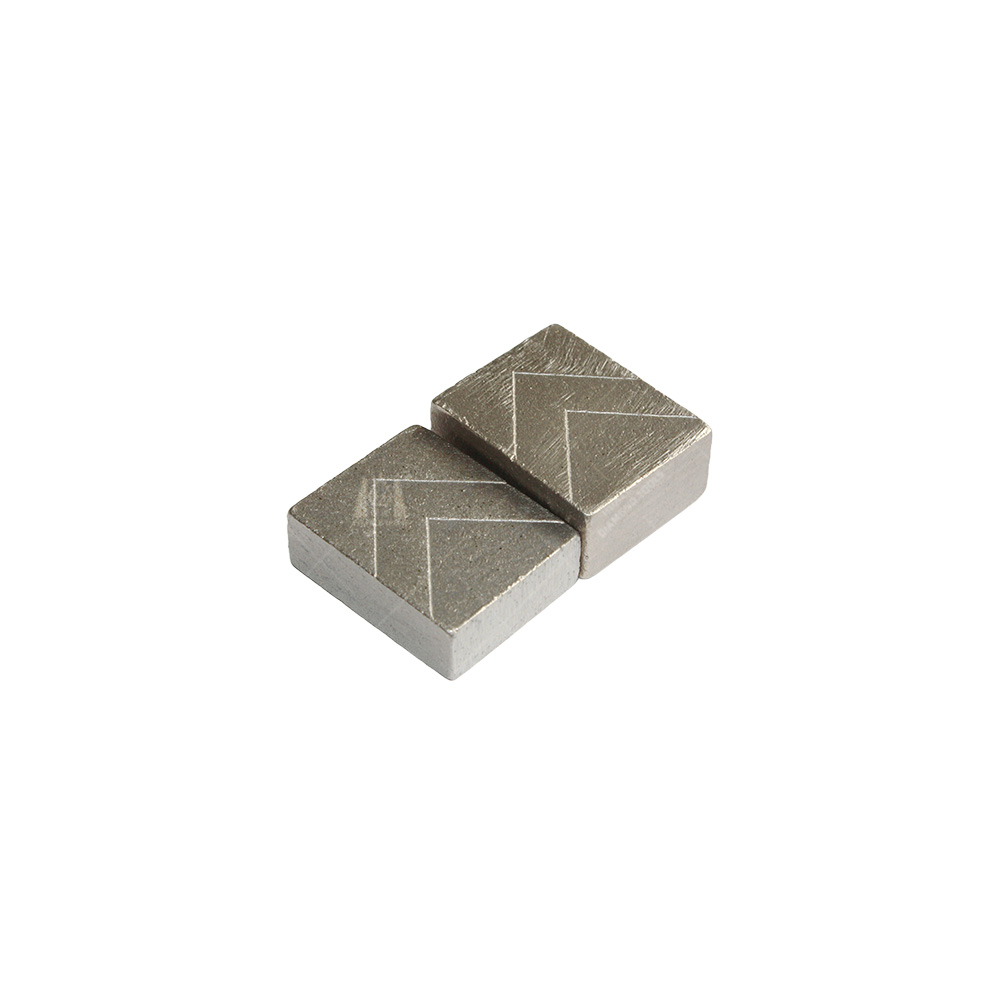
Segment geometry heavily influences the initial cutting "bite." Common shapes include M-shape, W-shape, grooved, and stepped designs. These specific geometric profiles reduce cutting resistance when the blade first enters the stone block. They minimize the contact area initially, allowing the blade to penetrate smoothly. Furthermore, grooved designs allow cooling water to penetrate deeper into the cut zone instantly.
Internal structure plays an equally vital role in straight cutting. The industry widely utilizes the "Sandwich" design. This structure features a softer middle layer flanked by harder outer metal sides. As the tool cuts through the block, the middle wears slightly faster. This deliberate wear pattern maintains a concave edge on the cutting face. A concave profile ensures straight, guided tracking without lateral deviation.
Single cutter operations differ vastly from high-volume multi-saw setups. A reliable multi saw blade segment requires strictly enforced consistency. Dimensions, weight, and tensioning compatibility must remain identical across the entire rack. Single-blade operations offer a wider margin for error. In a multi-saw environment, mismatched components in a single rack lead to catastrophic failure, warped blades, and ruined blocks.
Metallurgical consistency separates premium tools from cheap alternatives. Buyers must verify the supplier's manufacturing process. Look for facilities utilizing advanced cold or hot pressing combined with precision sintering. Proper automated sintering prevents varying metal densities within the same batch. Inconsistent density leads to uneven wear and unpredictable blade life.
Welding readiness represents another crucial checkpoint for procurement. Always assess the base layer, commonly called the welding transition layer. A high-quality granite cutting segment completely lacks diamonds in the bottom 1 to 2 millimeters. This clean blank zone guarantees a secure, high-frequency silver brazing process. Diamonds near the weld disrupt the metallurgical bond, drastically increasing the risk of segments dropping off during heavy operation.
Always evaluate supplier marketing claims with heavy skepticism. Many manufacturers aggressively promise "maximum speed and maximum lifespan" in the same breath. Physics dictates you cannot fully maximize both simultaneously. Instead, guide your team to ask for specific formulation adjustments based on your unique stone samples. Real experts discuss trade-offs rather than offering impossible miracles.
Never switch your entire production line to new diamond segments for granite overnight. You must follow a strictly controlled pilot testing protocol. Test a single blade first. If running a block cutter, use a small multi-blade rack for the initial trial. This isolates any potential failures without halting factory output.
Monitoring operational parameters carefully during this pilot phase is non-negotiable. Track your peripheral speed (measured in m/s) and your traverse speed (measured in m/min). Documenting these metrics allows you to establish a reliable performance baseline against your legacy tools.
Troubleshooting the rollout is a standard part of the adoption process. Pay attention to these common scenarios:
Risk: Segment Glazing. Symptoms include sparks flying, high amp draw, and the blade bouncing on the stone. Action: Reduce peripheral speed immediately or request a softer bond from the manufacturer.
Risk: Excessive Wear. Symptoms include a drastically short lifespan. Action: Verify your coolant flow is sufficient to clear abrasive slurry. If coolant is fine, switch to a harder bond or higher diamond concentration.
Finally, evaluate post-sale technical support as a primary shortlisting criterion. Ask yourself: Will the supplier tweak the formula based on your initial test data? A reputable manufacturer acts as a partner. They will gladly refine the matrix formula until performance peaks on your specific machines.
Selecting the right cutting tools remains a highly localized decision. Your final choice heavily depends on your specific granite type, machine condition, and operator skill level. Formulations performing brilliantly in a neighboring facility might fail completely under your roof. Success requires moving away from generic solutions and embracing targeted, data-driven procurement.
Your immediate next step is to audit your current primary cost-driver. Identify whether your main operational bottleneck is cutting speed, short lifespan, or excessive power consumption. Once you pinpoint the exact problem, request a customized sample batch from a manufacturer willing to formulate specifically to those parameters. Methodical testing always outshines marketing hype.
A: Formulations require adjustments whenever you encounter major geological shifts. Variations in quarry geology change the stone's hardness and quartz content. You might need seasonal or batch-based tweaks if you source rough blocks from different regional quarries. Consistent monitoring helps catch these shifts early.
A: Premature diamond loss typically points to a mismatch between the stone and the bond. Cutting highly abrasive granite with a soft bond washes away the metal matrix too fast, releasing diamonds before they dull. Additionally, insufficient coolant flow fails to flush out abrasive slurry, accelerating this rapid metal wear.
A: Taller segments theoretically offer a longer lifespan, but they introduce operational trade-offs. Extra height makes it harder for coolant to reach the active cut zone efficiently. It also increases the risk of lateral deflection under high feed rates. You must balance desired lifespan with structural stability.
A: No, you cannot use the same segment effectively. Marble and granite possess completely different mechanical properties. Marble features a lower hardness and forms chips differently during processing. It requires electroplated tools or distinctly different sintered bonds. Using a granite tool on marble typically results in severe edge chipping.


 No.351, Dingshi Jing, Shijing, Dongling Town, Huian, Quanzhou, Fujian, China
+86-595-86780371
+86-15905012435


