
 English

Views: 0 Author: Site Editor Publish Time: 2026-09-05 Origin: Site


Fabricating granite requires navigating a notoriously hard, quartz-rich surface. It generally rates between 6 and 7 on the Mohs scale. Choosing the wrong tooling directly leads to burnt edges. It also creates unsightly "orange peel" textures or rapidly depletes your abrasives. At the decision stage, your goal extends beyond merely achieving a high-gloss finish. You must optimize labor time. You also need to minimize the consumable expense per linear foot. Poor tool matching slows down production. It frequently ruins expensive natural slabs before they ever reach the installation site.
This guide breaks down how to select specific diamond polishing tools for granite. We will match these abrasives to your shop’s equipment. We will explore wet versus dry environments. We also cover complex edge profile requirements. By the end, you will understand the exact structural choices needed to achieve a flawless, factory-grade mirror finish.
Tool Matching: Harder stone requires softer bonds; utilizing a dedicated resin bond grinding disc is critical for preventing scratches on dark granite.
Wet vs. Dry Decisions: Wet polishing remains the industry standard for shop fabrication due to longevity and dust control, while dry pads are strictly for on-site, low-RPM touch-ups.
Grit Sequence Discipline: Skipping grits degrades the final polish; ROI is maximized by allowing lower-grit granite polishing discs to do the heavy lifting.
RPM Management: Operating beyond tool specifications (typically 2,000–4,000 RPM) guarantees premature pad failure and potential stone discoloration.
Understanding granite's unique composition is the first step in mastering surface fabrication. Granite consists primarily of feldspar, quartz, and mica. This interlocking crystalline structure makes it incredibly dense. You cannot treat it like softer marble, which contains calcite. You also cannot treat it like engineered quartz, which relies on polymer resins. Granite demands aggressive mechanical abrasion. The tooling must withstand intense friction without glazing over.
This brings us to the bond hardness matrix. Fabricators often struggle with a highly counter-intuitive abrasive rule. Hard stones like granite require tools featuring a softer matrix bond. Why? As the pad spins against the dense stone, the diamonds dull quickly. A soft bond wears away at a controlled pace. This continuous wearing action exposes fresh, sharp diamonds. If you use a hard bond on granite, the matrix holds onto the dull diamonds. The pad stops cutting and simply generates excessive heat.
You must approach manufacturer claims regarding "universal" stone pads critically. A universal pad compromises on bond hardness. A pad optimized to cut soft marble beautifully will almost certainly glaze over on dense granite. It will fail to release dull diamonds fast enough. You end up applying more downward pressure to force the cut. This ultimately damages both the pad and your equipment.
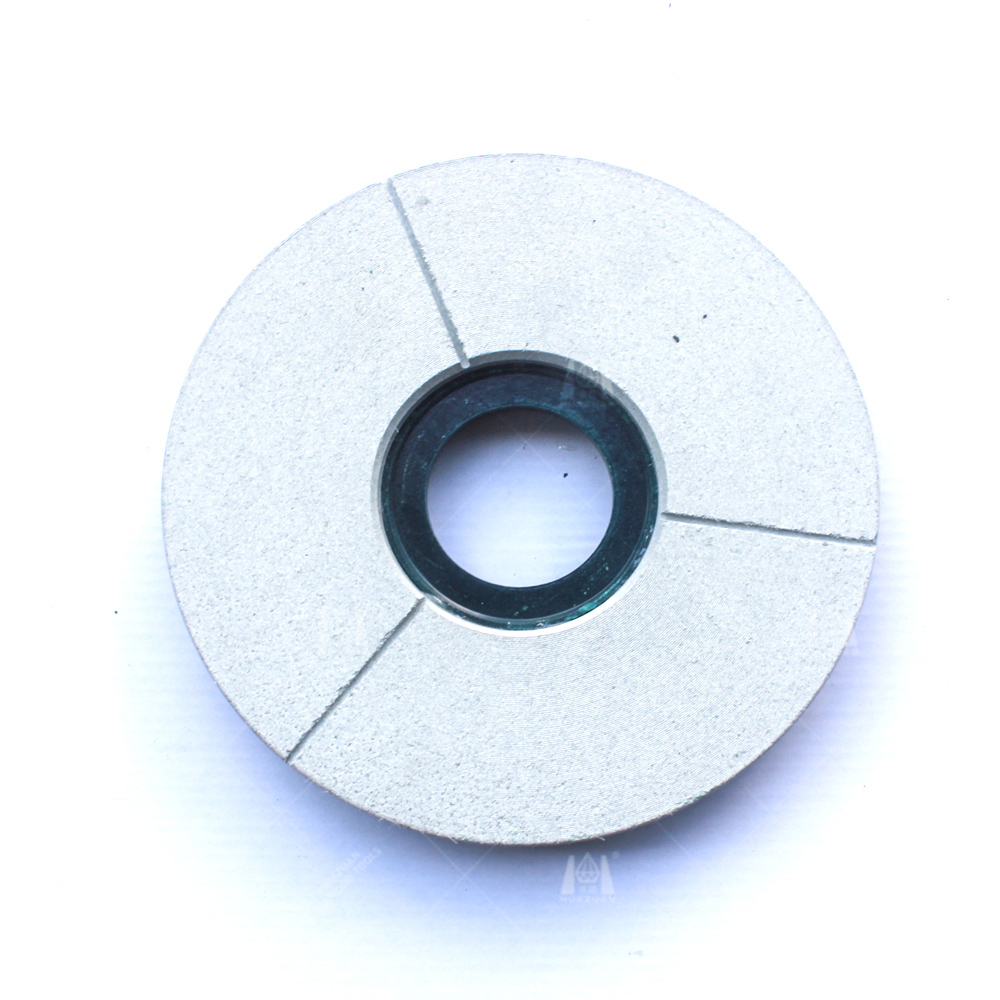
Fabricators rely on specific tool categories to move a slab from rough shaping to a final mirror polish. Each category serves a distinct physical purpose in the fabrication workflow.
We use metal and copper bond pads primarily for aggressive stock removal. You will typically find these in grits ranging from 30 to 200. They excel at initial shaping, leveling uneven seams, and grinding down saw marks. They offer high durability and excellent heat resistance. However, they leave deep scratch patterns behind. You must execute careful transitions to lighter grits to erase these gouges completely.
Once the heavy shaping concludes, the true polishing begins. The resin bond grinding disc acts as the core workhorse here. These discs handle honing and high-gloss finishing duties across grits from 400 to 3000. They deliver exceptional finish quality. However, they remain highly vulnerable to melting. If you run them dry at excessive RPMs, the resin smears across the stone surface.
You must also choose between flexible and rigid structures. A flexible diamond pad bends seamlessly. This flexibility proves essential for polishing complex architectural profiles like ogee, bullnose, or cove edges. The backing flexes without cracking the internal resin. Conversely, rigid pads reign supreme for flat surface polishing. They prevent surface waviness, commonly known as cupping, when polishing straight or beveled edges.
Selecting the correct abrasive requires aligning the tool's specifications with your shop's physical environment. You must evaluate four critical factors before making a procurement decision.
Wet polishing remains mandatory for professional shop environments. Water acts as a crucial coolant. It also evacuates the stone slurry efficiently. This continuous flushing extends pad life by up to three times compared to dry running. Dry polishing pads remain necessary only for residential install touch-ups. Dry pads require highly heat-resistant resin to survive without water.
Application Comparison: Wet vs. Dry Environments
Application Type | Primary Use Case | Cooling Mechanism | Expected Lifespan | Environmental Dust |
|---|---|---|---|---|
Wet Polishing | Shop fabrication, heavy profiling | Continuous water flow | Extended (Up to 3x longer) | Zero (Slurry safely drains) |
Dry Polishing | On-site installation touch-ups | Airflow / Heat-resistant resin | Shorter due to thermal wear | High (Requires vacuum shrouds) |
Fabricators constantly debate between 3mm and 5mm pad thicknesses. Thicker 5mm pads undeniably offer a longer overall lifespan. However, they often lack immediate flexibility out of the box. They struggle initially on tight edge radiuses. Thinner 3mm pads conform instantly to complex curves but require more frequent replacement.
Never underestimate color specificity when choosing a stone finishing abrasive. Using dark resin pads on white or light-colored granite risks severe color bleeding. The friction forces the dark dye into the open pores of stones like Kashmir White. Always highlight and stock white-resin pads specifically for light stone jobs.
Finally, verify structural integrity against your tools. Check the center water feed requirements. Ensure the hook-and-loop backing strength matches the torque of your pneumatic or electric polishers. A weak velcro backing will detach at 4,000 RPM, creating a severe safety hazard.
Even the highest-quality pads fail if you execute the grit sequence poorly. Discipline during the progression dictates the final clarity of the stone.
We document a strict, non-negotiable sequence for dense granite. You must follow this step-by-step path to avoid cloudy finishes.
Grit 50: Heavy grinding and initial shaping.
Grit 100: Refining the shape and removing deep 50-grit scratches.
Grit 200: Finalizing the flat hone and preparing for color enhancement.
Grit 400: Introducing the initial low-sheen polish.
Grit 800: Developing a noticeable reflection and closing stone pores.
Grit 1500: Pushing the stone into a high-gloss state.
Grit 3000: Achieving maximum mechanical clarity.
Buff Stage: Final chemical-mechanical reaction for a mirror finish.
Many novices rush the early stages. Emphasize to your team that 70% of the actual work occurs at the 50, 100, and 200 grit stages. These lower grits do the heavy lifting. If you rush them, no amount of time spent at 3000 grit will fix the underlying scratches.
How do you verify it is time to move up? Visually inspect the surface after thoroughly drying it. You want to see uniform scratch pattern removal. The previous grit's marks must disappear completely before attaching the next granite polishing disc.
The Buff pad plays a unique role. It combines ultra-fine diamonds with chemical polishing compounds. Use a Black Buff pad exclusively for dark granites like Absolute Black. Use a White Buff pad for lighter stones. This final step pulls out the dark, rich "factory-like" mirror reflection.
Fabrication shops routinely lose money to preventable tool failures. Recognizing these failure modes early saves significant operational expenses.
Overheating and Resin Smearing: This occurs almost entirely due to exceeding maximum RPM limits. Running a pad beyond 4,000 RPM or utilizing inadequate water flow melts the resin directly into the stone's pores.
The "Orange Peel" Effect: This wavy, uneven texture results from skipping intermediate grits. Jumping directly from 400 to 1500 forces the higher grit to overwork. It polishes the peaks of the stone but misses the valleys.
Center Pad Blowouts: When the center of a pad disintegrates prematurely, operator error is usually to blame. Excessive downward pressure crushes the resin. You must let the diamond concentration execute the cutting action.
Mitigation Strategy: Establish clear shop standard operating procedures (SOPs). Mandate specific pressure guidelines. Lock RPM settings on variable tools. Most importantly, install mandatory grit inspection lighting at fabrication tables to spot stray scratches early.
Matching the right tool to granite requires understanding the delicate balance between the abrasive and the stone. The right decision aligns the pad's bond hardness, flexibility, and wet/dry rating strictly with your specific equipment and edge profiles. Hard stones simply demand softer bonds to keep fresh diamonds exposed.
For procurement, we highly recommend testing a full grit sequence from a single manufacturer first. This strategy ensures consistent bond graduation and scratch removal before you commit to bulk shop orders. Mixing brands mid-sequence often leads to uneven polishing.
Your immediate next steps involve an equipment audit. Review the actual RPM limits of your shop's polishers. Assess your current consumable spend related to premature pad wear. Finally, request detailed technical specification sheets for any shortlisted tools to verify their bond matrix matches your granite inventory.
A: The optimal speed typically ranges between 2,000 and 4,000 RPM. Exceeding 4,000 RPM causes the internal resin to melt and glaze the stone surface. Conversely, running the pad too slowly significantly reduces cutting efficiency and drags out your labor time.
A: Yes, but only for specific scenarios. 3-step systems remain highly viable for quick installation touch-ups or light commercial work. However, to achieve a true, long-lasting factory edge on dense granite, a traditional 7-step sequence remains highly recommended.
A: You are likely using a pad formulated with a dark resin bond. When spinning at high speeds, the dark resin bleeds into the stone's open pores. For light-colored granites like Kashmir White, strictly use white or clear resin-bonded pads to prevent this color transfer.


 No.351, Dingshi Jing, Shijing, Dongling Town, Huian, Quanzhou, Fujian, China
+86-595-86780371
+86-15905012435


